Meta Just Put an 816B Parameter AI Model on Your Desktop
Meta's Muse Spark Open is an 816B-parameter open-weight model designed to run locally on Apple Mac Studios, blurring the line between cloud and local AI.

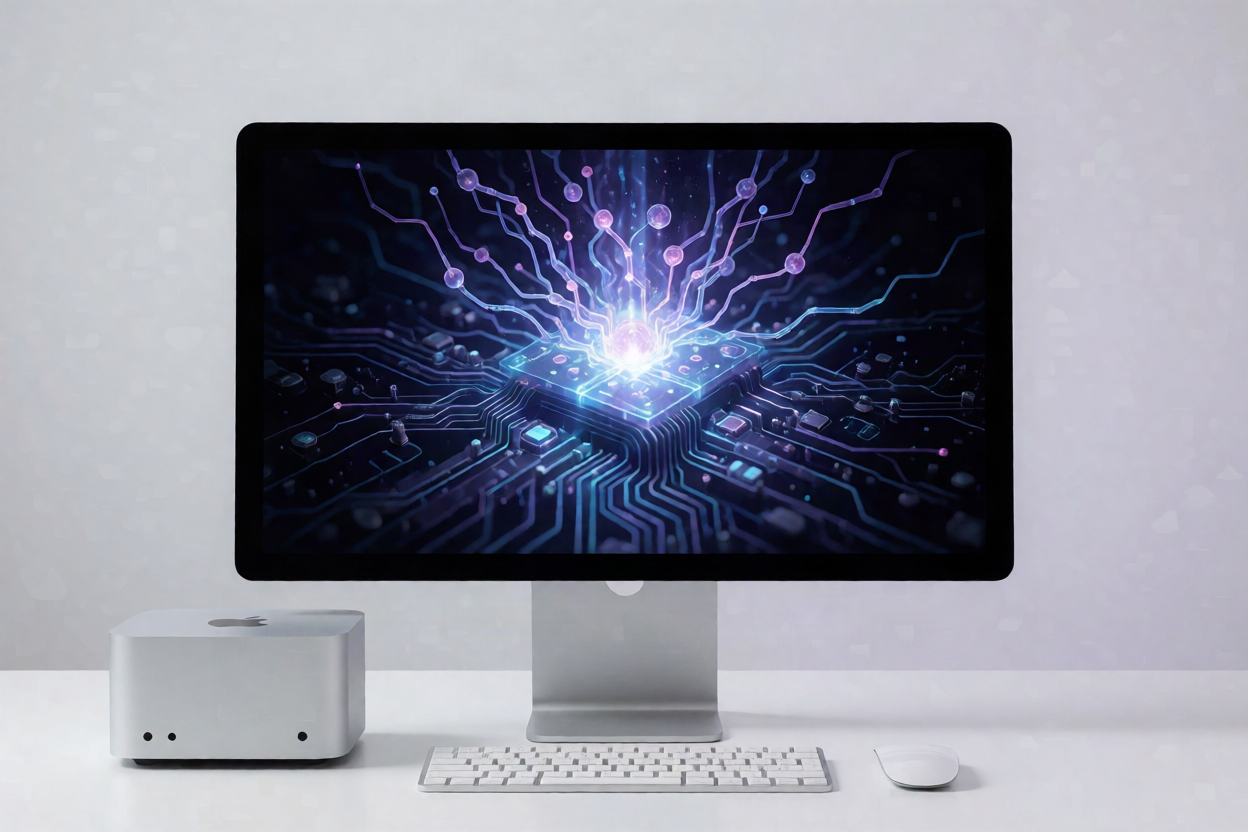
For years, the assumption in AI has been simple: the most powerful models live in the cloud. If you wanted frontier-level intelligence, you sent your data to someone else's server. Meta's latest release challenges that assumption head-on.
On October 15, 2026, Meta dropped Muse Spark Open, an 816-billion-parameter open-weight model designed to run locally on desktop hardware. Not a watered-down version. Not a "distilled" variant. The full model, co-developed with Apple, is built to operate on two to four M5 Ultra Mac Studios using Apple's MLX framework. Meta calls it the "most capable US open-weight model to date," and while that claim will face scrutiny from the benchmarking community, the underlying technical achievement is hard to dismiss.
The model itself is a mixture-of-experts architecture, which means only about 42 billion parameters are active per token. That design choice is what makes running it on desktop hardware feasible at all. An 816B-parameter model in full precision would laugh at consumer hardware. But with MoE, each token only needs the relevant "expert" slice of the model, dramatically reducing memory requirements. Even so, you are still looking at needing a terabyte of unified memory across linked Mac Studios. This is not going to run on your MacBook Air.
The Apple collaboration is perhaps the most surprising element here. These are two companies that have spent years in various states of tension, from Apple's 2021 privacy changes that kneecapped Meta's ad business to their ongoing competition in mixed reality. Yet here they are, with Meta optimizing its most capable open model for Apple's silicon. Alexandr Wang, Meta's AI chief, even joked to Axios that the companies are "excited for mommy and daddy to be playing nice again."
The partnership makes sense technically. Apple's M5 Ultra Mac Studio offers up to 512GB of unified memory per machine, with 1.2TB/s memory bandwidth. Link two of them together and you have the memory pool to host a model this large locally. Apple updated its MLX framework specifically to support Muse Spark Open, improving communication between linked Macs and adding support for the M5 Ultra's GPU Neural Accelerators.
What is actually striking about this release is what Meta demonstrated the model doing. They paired it with Muse Code, their AI coding terminal, and showed it shipping real code changes to an open-source iOS Mastodon client. Bug fixes, new features, full builds. They also had it driving DaVinci Resolve end-to-end, reviewing footage frame by frame to identify strong moments and crop them into vertical formats.
These are not toy demos. They are real, multi-step agentic workflows running entirely on local hardware. That matters because it points to a future where AI agents handling sensitive code or creative work never need to leave your machine. For companies worried about sending proprietary data to cloud APIs, that is a genuinely different value proposition.
The release also lands in an interesting competitive context. Earlier this year, Meta shifted away from its open-weight Llama strategy with the release of Muse Wonder, its first closed frontier model. Muse Spark Open represents a return to open weights, but at a scale and capability level that dwarfs anything Meta has released before. It also dropped the same day as NVIDIA's Nemotron 3.5 open models, making October 15 an unusually busy day for the open-weight ecosystem.
Muse Spark Open is available now on Hugging Face and through several API platforms, with support for AMD, Apple, Intel, and NVIDIA hardware. Meta says it conducted additional post-training safety work and assessed the model under its Superintelligence Scaling Framework before release.
Whether this actually becomes a practical tool for developers depends on whether independent benchmarks validate Meta's performance claims, and whether the community can make the Mac Studio setup work reliably in production. But the signal is clear: the boundary between "cloud AI" and "local AI" is blurring, and Meta is betting that the future includes room for both.